Physical Address
304 North Cardinal St.
Dorchester Center, MA 02124
Physical Address
304 North Cardinal St.
Dorchester Center, MA 02124

Through Diversity and Inclusion
Through Diversity and Inclusion
Not Just Scrolling—Learning With Purpose
Social media learning is no longer peripheral to professional development; it has become embedded in how educators access, exchange, and construct knowledge. Social media mining is the intentional process of searching for, analyzing, and engaging with online content to support specific learning goals rather than passively consuming information. With the rise of technology, education has shifted toward more interactive, participatory environments. Microblogging platforms such as X (formerly Twitter) exemplify this shift by enabling microlearning through short posts, threads, videos, and visual infographics.
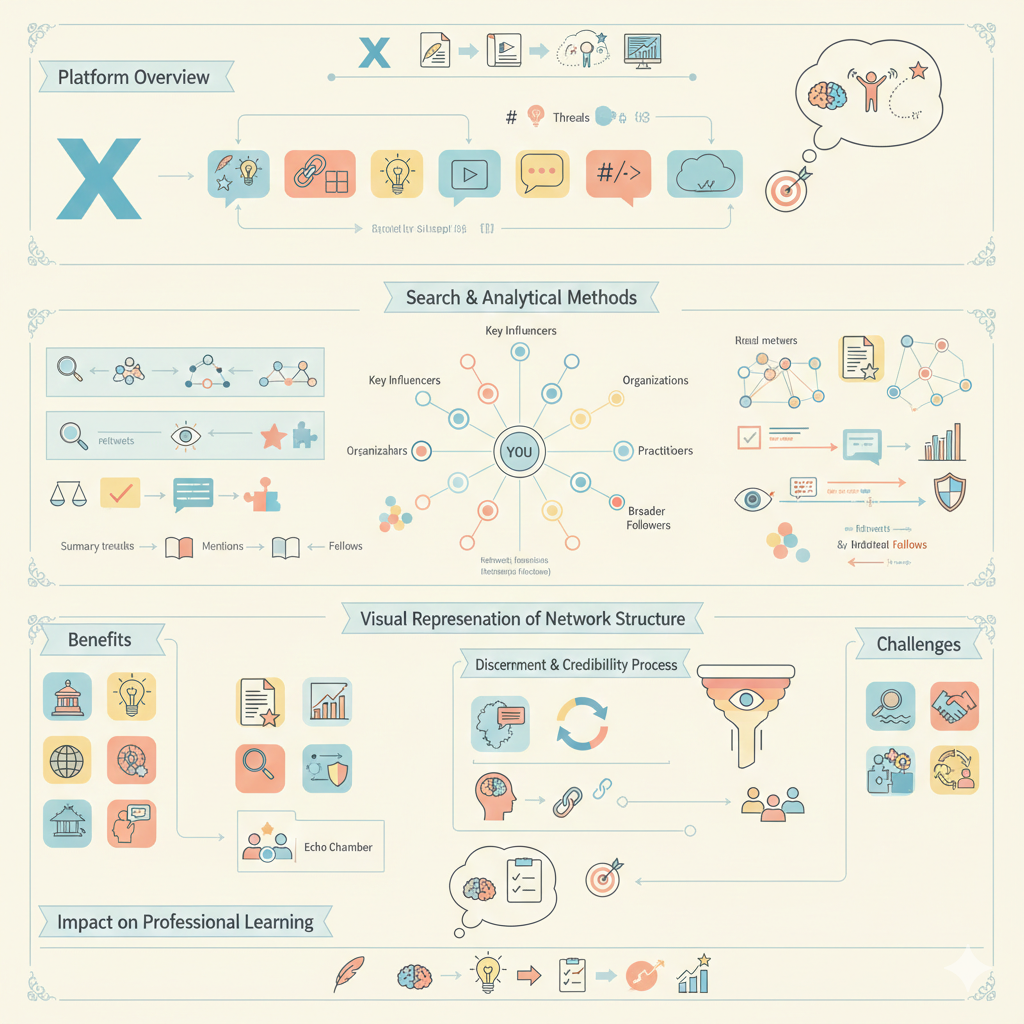
The accompanying infographic illustrates how X supports meaningful professional learning when used strategically. Its short-form structure aligns with just-in-time learning, allowing educators to access focused insights in manageable segments—reducing cognitive overload while fitting into busy schedules. Research shows that social media networks (SMNs) foster engagement and support adult learning principles, while microblogging platforms like Twitter enhance collaboration and interaction (García-Río et al., 2022). The infographic also visualizes the network structure of X, highlighting key influencers (high-centrality nodes), broader professional communities, and the interactions—retweets, mentions, replies—that shape knowledge flow. However, clustered communities can also create echo chambers if not approached critically.
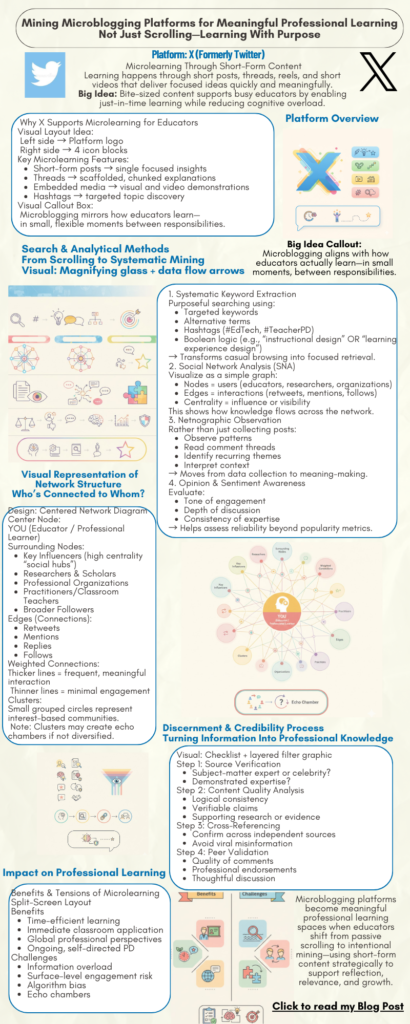
To maximize effectiveness, educators should move from scrolling to systematic mining. Begin with targeted hashtags (e.g., #EdTech, #TeacherPD) and refine searches using alternative keywords. Follow credible subject-matter experts rather than popularity-driven accounts. Save and curate valuable posts for later reflection, and read comment threads to understand context. Equally important is setting intentional time boundaries, as research cautions that social media can lead to time wastage without a clear purpose.
Credibility discernment is essential. Educators should verify sources, evaluate logical consistency and supporting evidence, cross-reference claims, and observe peer validation through professional discussion. Reflective engagement and critical evaluation are key to transforming microblogging into meaningful learning (García-Río et al., 2022). Similarly, Alshalawi (2022) emphasizes that intentional participation and credibility assessment significantly influence learning performance and perceptions of educational value.
When approached critically and strategically, microblogging platforms become powerful tools for ongoing, self-directed professional development. The shift is simple but significant: from passive scrolling to purposeful mining—using short-form content intentionally to support reflection, relevance, and professional growth.
Alshalawi, A. S. (2022). The influence of social media networks on learning performance and students’ perceptions of their use in education: A literature review. Contemporary Educational Technology, 14(4), 1–20. https://doi.org/10.30935/cedtech/12164
García-Río, E., Baena-Luna, P., Palos-Sánchez, P., & Aguayo-Camacho, M. (2022). Microblogging: an online resource to support education and training processes. Campus Virtuales, 11(2), 39–48. https://doi.org/10.54988/cv.2022.2.1013